
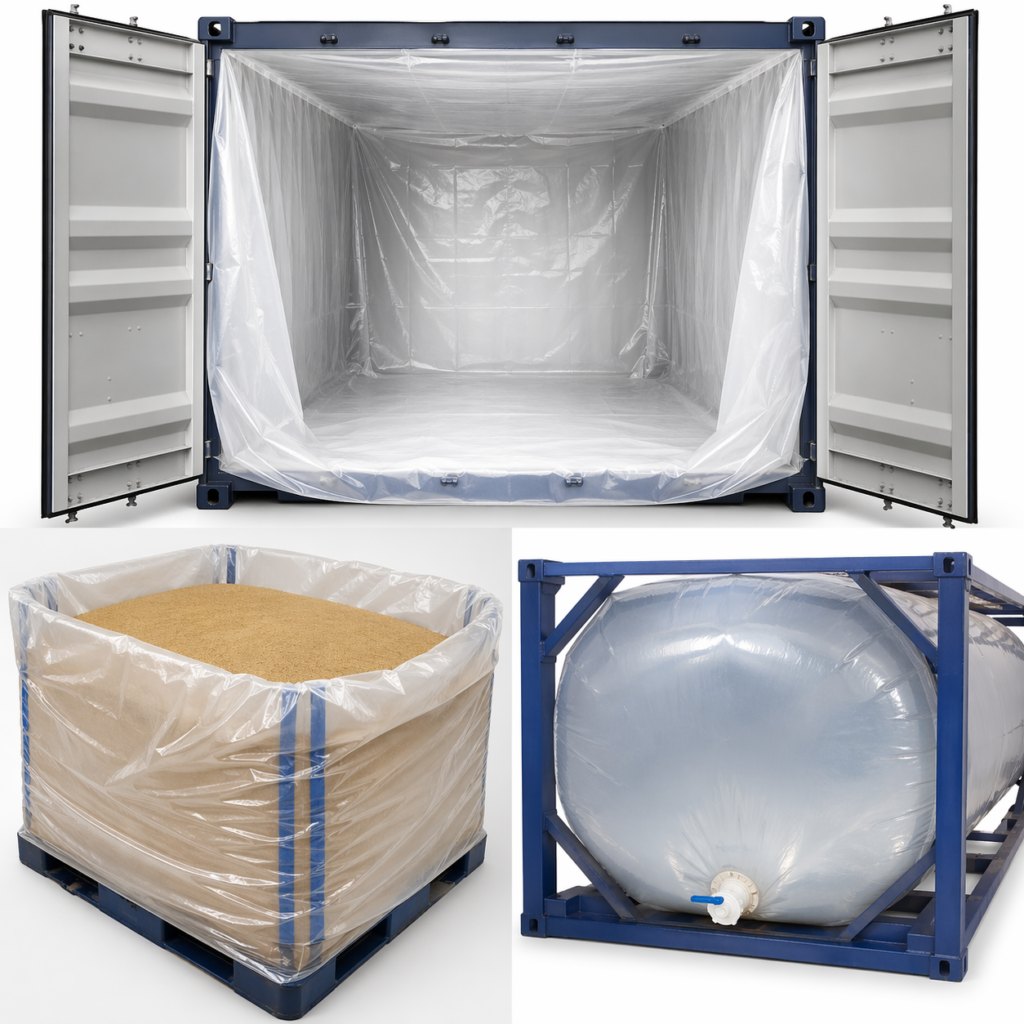
Polyethylene Container Liners
Polyethylene container liners extend the container liner concept into applications where the product requires a moisture barrier, a chemical barrier, or complete liquid containment that woven PP fabric cannot provide. PE film liners are used as standalone liners for moisture sensitive dry bulk products, as inner liners inside PP woven outer liners for enhanced barrier performance, and as purpose-built liquid liners for wine, juice, oils, and liquid bulk commodities.
➤ PE Film Container Liner — Moisture Barrier
A PE film container liner is a single or multilayer polyethylene film bag manufactured to container dimensions. It provides a complete moisture vapour barrier for hygroscopic dry bulk products that would absorb moisture through a ventilated or open PP liner chemical powders, pharmaceutical ingredients, hygroscopic food ingredients, and any product where moisture ingress during ocean transit causes caking, clumping, or quality degradation.
Available as a standalone liner or as an inner PE liner within a structural PP woven outer liner the outer PP liner provides the load-bearing structure; the inner PE liner provides the moisture barrier.
Material: Single or multilayer PE film Barrier Performance: Complete moisture vapour barrier confirmed to product sensitivity Configuration: Standalone PE liner · Inner PE liner inside PP woven outer Thickness: 100 – 250 micron depending on barrier requirement and product weight Fill Configuration: Open top · Fill spout Discharge: Spout · Door slit Best For: Hygroscopic food ingredients, chemical powders, pharmaceutical intermediates, any moisture-sensitive dry bulk product on long ocean voyages
➤ PE Liquid Container Liner — Wine, Juice and Liquid Bulk
The liquid PE container liner — also known as a flexibag or bulk liquid liner — transforms a standard 20ft shipping container into a liquid bulk tanker, carrying between 14,000 and 24,000 litres of liquid product in a single container without the cost and complexity of ISO tank hire, cleaning, and repositioning.
For wine exporters, juice producers, vegetable oil shippers, and liquid food commodity traders, the liquid container liner is the cost-effective bulk liquid shipping format for volume routes. A 20ft container fitted with a liquid liner carries the equivalent of approximately 26,000 standard 750 ml wine bottles in a single shipment — at a fraction of the cost of bottled shipping for product destined for bottling at the destination market.
The liner is installed inside the container, filled through the inlet valve at the rear, and sealed for transport. At destination, the discharge valve releases the liquid by gravity or pump into the receiving tank. The liner is single-use — it is removed and disposed of after discharge, leaving the container clean and available for the next load without the cleaning cycle that ISO tanks require.
Material: Multilayer PE film — food contact grade Capacity: 14,000 – 24,000 litres (confirmed to product specific gravity and container) Container Fit: 20ft standard · 40ft on request Fill: Inlet valve pump or gravity fill Discharge: Discharge valve — gravity or pump-assisted Food Contact: FDA 21 CFR · EFSA compliant — virgin PE, food-safe throughout Temperature Range: Ambient temperature products chilled product liners on request Products Carried: Wine the single largest application globally for liquid container liners — Fruit juices and juice concentrates — Vegetable oils and edible oils Liquid sweeteners (glucose syrup, liquid sugar) — Non-food liquid chemicals — industrial grade liners available Best For: Wine exporters shipping to bottling operations in destination markets · Juice and beverage producers · Edible oil traders · Liquid food commodity exporters on high-volume routes where bulk liquid shipping economics justify the format
➤ Why Wine Exporters Choose Liquid Container Liners
Wine shipped in bulk in a container liner arrives at the destination bottling facility at a cost per litre that bottled shipping cannot match. The elimination of bottle, cork, label, carton, and palletisation costs on the export leg — combined with the freight efficiency of liquid bulk versus the dead weight and space of glass bottles — produces a landed cost advantage that is significant on any volume route.
For wineries supplying private-label programmes, branded entry-level tiers, and export volumes destined for bottling in market, the liquid container liner is the supply chain format that makes the economics work. It is the reason bulk wine trade between the Southern Hemisphere and European bottling markets has grown consistently for two decades.
If you are currently shipping bottled wine on routes where destination-market bottling is viable — or if you are evaluating the bulk wine shipping format for the first time — the liner specification, the filling and discharge logistics, and the food safety documentation are all confirmed at enquiry stage.