
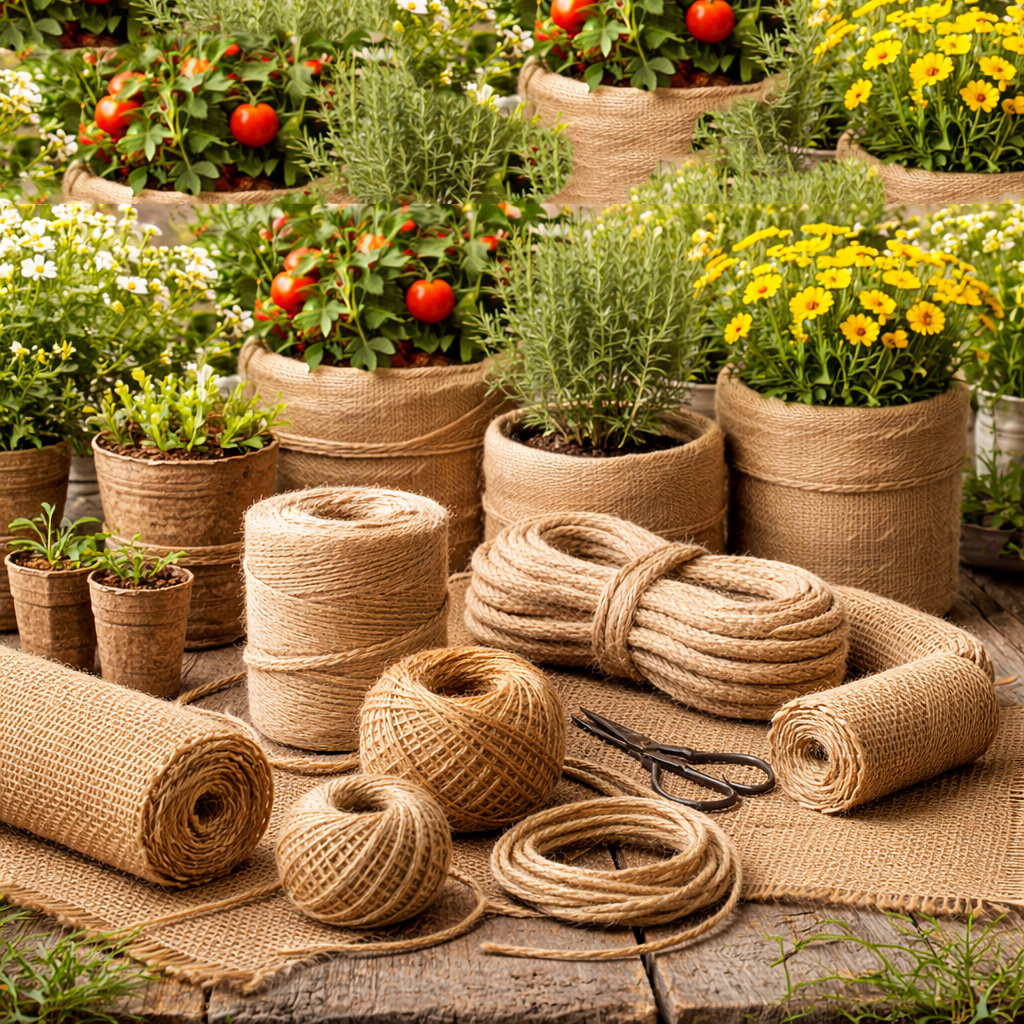
Jute Soil Saver
Topsoil is one of the most valuable and most vulnerable resources in any landscaping,
horticulture, or civil engineering project. On slopes, embankments, newly planted areas, and
disturbed ground, unprotected topsoil erodes in the first heavy rain event — sometimes
before the first plant has established. What takes decades to form washes away in an
afternoon.
The jute soil saver is an open-mesh jute fabric mat or roll that is laid directly on the soil
surface — over seeds, over new plantings, over exposed embankments — and pegged in
place. The mesh holds the topsoil particles in position against the erosive force of rainfall
and surface water flow. It allows rain to penetrate to the soil and seeds below. It allows
emerging seedlings to grow through the mesh openings without obstruction. And then, as
the plants establish and their root systems begin to stabilise the soil naturally, the jute mesh
degrades — returning to the soil as organic matter at exactly the point when it is no longer
needed.
The soil saver does not need to be removed. It does not leave synthetic residue. It does not
need to be disposed of. It simply disappears on schedule, having done its job.
Mesh Construction: Open-weave jute — allows rain penetration and seedling emergence
Biodegradation: 1–2 growing seasons Installation: Laid on soil surface, pegged at edges
and overlaps Roll Dimensions: Custom width and length — standard 1 m × 25 m, 1 m × 50
m, 2 m × 25 m Custom Sizes: Yes Colours: Natural Best For: Slope stabilisation,
embankment protection, erosion control on new plantings, seedbed protection, land
rehabilitation, civil engineering ground cover, commercial landscaping
Jute Trellis Netting
Jute trellis netting is a large-aperture open-mesh jute net used as a climbing support
structure for plants, vegetables, and vines — and as a biodegradable temporary barrier,
privacy screen, or training support in garden and horticultural applications.
Unlike synthetic trellis netting that must be removed, cleaned, and disposed of at the end of
each growing season, jute trellis netting can be composted or turned into the soil at the end
of the season along with the plant material. This reduces the labour of post-season garden
cleanup and eliminates the plastic waste that accumulates from repeated use of synthetic
netting.
Jute trellis netting is used by commercial growers, gardeners, and landscapers for
supporting climbing beans, peas, cucumbers, tomatoes, and ornamental climbers. It is also
used in event and retail environments as a decorative natural backdrop — the open-mesh
structure and natural colour provide a versatile visual support for hanging displays, signage,
and decorative foliage.
Aperture Size: Large open mesh — sized for plant climbing and support Biodegradation:
Seasonal — compostable with plant waste Roll Dimensions: Custom width and length
Custom Sizes: Yes Best For: Climbing vegetables and vines, garden trellising, ornamental
climbers, commercial growing operations, post-season composting applications, decorative
event and retail displays
Jute Tree Wrap
A newly planted or transplanted tree is vulnerable to three specific threats in its first
growing season: sunscald from direct winter sun on thin bark, frost cracking from rapid
temperature changes between day and night, and mechanical damage from machinery,
lawnmowers, animals, and rough handling during establishment.
Jute tree wrap addresses all three. A strip of burlap fabric wound spirally around the trunk
from the base upward insulates the bark against temperature fluctuation, shades it from
direct winter sunlight, and provides a physical buffer against minor mechanical contact.
Unlike synthetic tree wraps that must be removed in spring to prevent girdling and bark
damage, jute tree wrap degrades naturally through the growing season — it can be left on
the tree as it loosens and falls away without causing the constriction damage that synthetic
wraps cause if forgotten.
Jute tree wrap is standard practice in commercial tree planting, arboriculture, golf course
and estate landscaping, and municipal planting programmes where post-installation
maintenance access is limited.
Application: Wound spirally around trunk base-upward Protection: Sunscald · Frost
cracking · Minor mechanical damage Biodegradation: Seasonal — does not need removal in
spring Width: 10 cm standard — custom widths available Roll Length: 25 m, 50 m —
custom on request Custom Sizes: Yes Best For: Commercial tree planting, arboriculture,
estate and golf course landscaping, municipal planting programmes, transplant
establishment, winter protection
Jute Planter Bag
The jute planter bag brings together the structural function of a growing container and the
biodegradable property of jute in a single product. Plants grown in jute planter bags can be
transplanted directly into the ground — bag and all — without removing the root ball. The
jute degrades in the soil over the first growing season, allowing roots to penetrate naturally
through and beyond the bag walls as the plant establishes.
This eliminates the root disturbance, transplant shock, and handling damage that occurs
when plants are removed from rigid containers before planting. For large-scale planting
programmes — roadside tree planting, commercial nursery operations, reforestation, and
estate landscaping — the ability to plant without de-potting significantly reduces installation
time and improves establishment survival rates.
Jute planter bags are available in a range of sizes from small propagation tubes to large
tree-planting bags, in natural burlap fabric, with and without base reinforcement.
Construction: Burlap fabric, sewn base, open top Transplant Method: Plant directly in
ground — bag degrades in soil Biodegradation: 1–2 growing seasons in soil Sizes: From 10
cm diameter propagation bags to 50 cm diameter large planter bags Custom Sizes: Yes
Best For: Commercial nurseries, tree planting programmes, reforestation, estate
landscaping, roadside planting, propagation and establishment applications